Don Quixote and Sancho Panza’s enduring companionship
Don QuixoteDon Quixote and Sancho Panza’s enduring companionship begins with an offer of advancement and deepens through shared journeys, disagreement, advice, and separation. Sancho follows his master in hope of becoming a governor, yet their bond comes to rest on more than that promised reward: Don Quixote values Sancho’s judgment and presence, while Sancho ultimately chooses their familiar partnership over the authority he has long anticipated.
Recruitment and the Promise of Reward
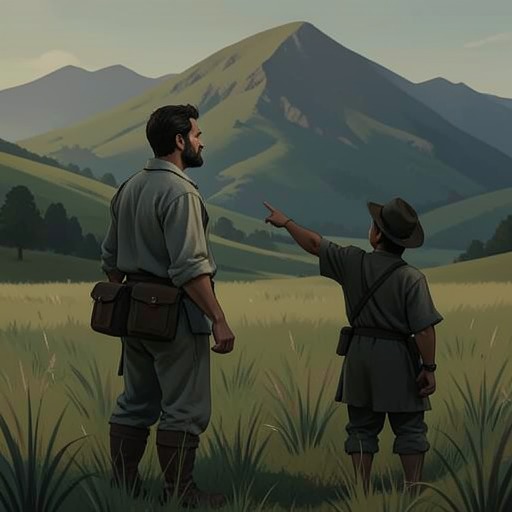
After fifteen quiet days at home, Don Quixote turns his attention to another journey and persuades his poor farm-labourer neighbour to accompany him as squire. He presents the possibility of an island governorship as an almost immediate reward for service. Sancho accepts, leaving his wife and children behind. The arrangement begins in unequal circumstances: Don Quixote supplies the vision and promises, while Sancho risks the security of home in pursuit of a future position.
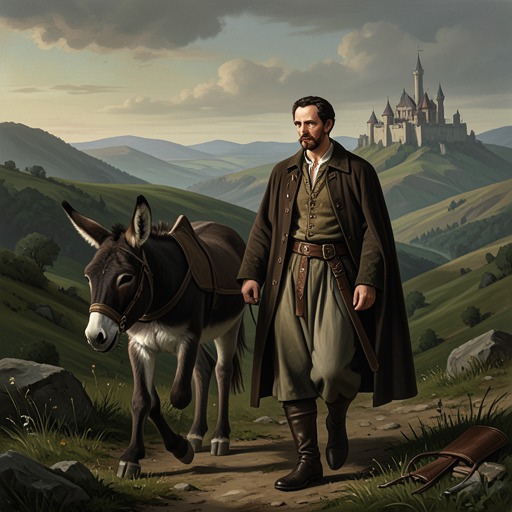
The practical preparations already show how differently they approach the road. Don Quixote gathers money by selling and pawning possessions, borrows a buckler, and repairs his battered helmet. He tells Sancho to bring provisions in his alforjas; Sancho also insists on taking his ass, since he does not want to travel on foot. Don Quixote briefly searches his memory for a precedent for a squire riding an ass, finds none, but accepts the choice and imagines that he may later provide Sancho with a more honourable mount. They leave their village secretly at night, without taking leave of their families, and travel by way of Campo de Montiel.
On the road Sancho returns to the central promise, assuring Don Quixote that he is capable of governing an island of any size. Don Quixote answers by placing the offer within the customs of knight-errantry: squires, he says, have received territories and titles from the knights they served. He then enlarges the promise, imagining that within days Sancho might rule not merely an island but a kingdom dependent on a greater realm. Their exchange establishes a recurring tension: Sancho treats the reward as a concrete prospect, while Don Quixote gives it meaning through the extravagant expectations of chivalric romance.
Shared Rules, Different Temperaments
Their companionship is tested by the rules Don Quixote brings to each encounter. Near Puerto Lapice, he instructs Sancho not to draw his sword in a fight against knights unless Sancho himself has been dubbed a knight; only against common attackers may the squire assist him. Sancho agrees to respect the restriction where his master is concerned, but distinguishes it from the right to defend himself. Don Quixote accepts that qualification while asking him to restrain his natural impulse to intervene. Their agreement is neither simple obedience nor open defiance: Sancho follows his master’s code while keeping hold of his own practical judgment.
After the encounter with the friars’ muleteers, Sancho approaches Don Quixote as he returns to Rocinante. He holds the stirrup and kneels to ask for the island he believes has been won in the fight. Don Quixote corrects his expectations, explaining that this was a roadside adventure rather than one that yields territory, and asks him to be patient. Sancho thanks him, helps him mount, and follows as they ride away. The episode repeats their familiar pattern: Sancho turns an adventure toward the promised reward, while Don Quixote interprets its meaning through the categories of his imagined vocation. Yet the correction does not dissolve their partnership; Sancho continues after his master, even when Rocinante’s pace leaves him behind and he has to call for Don Quixote to wait.
Their differences also appear in what each can endure and what each takes seriously. During the preparations for Clavileño, Sancho is visibly frightened and asks whether he may commend himself to God. Don Quixote notices his fear and draws him aside. He urges Sancho to begin paying the lashes required to disenchant Dulcinea del Toboso, proposing that even five hundred would be a useful start toward the full number. Sancho refuses to begin at that moment, objecting that the journey ahead is already demanding and promising to attend to the obligation later. Don Quixote presses the task; Sancho resists without abandoning him. The exchange makes their intimacy plain in a less triumphant register: one treats the enchantment as a serious chivalric duty, while the other negotiates its costs in the circumstances immediately before him.
Counsel and the Governorship
Before Sancho leaves to take up his government, Don Quixote warns him that the office may expose the limits of his judgment, but also recognizes qualities in him that learning alone cannot supply. He tells Sancho to make doing right his fixed purpose and entrust himself to God. Sancho, in turn, acknowledges that he knows little about governing and says that he would rather remain himself than gain office at the cost of his soul. Don Quixote takes this answer as evidence of sound natural judgment and affirms that Sancho deserves authority. Their exchange complicates the apparent hierarchy between master and squire: Don Quixote is the one who gives counsel, but Sancho’s plain-spoken moral choice earns his master’s respect.
When Sancho sets out, he wears the dress of a lawyer, with a tawny camlet garment and matching cap, and rides a mule. The Duke has arranged for Dapple to follow with new trappings of his own. Sancho repeatedly turns to look at the ass, pleased to have him nearby. He receives the Duke and Duchess’s farewell and Don Quixote’s blessing; both master and squire part in tears. The departure alters the ordinary shape of their service. Don Quixote is left without the companion whose presence has become part of the journey, and he feels the loss as soon as Sancho is gone. When the Duchess offers other attendants, he declines their service and asks to wait upon himself.
Even while they are apart, Don Quixote continues to guide Sancho by letter. Hearing that Sancho has shown good sense rather than the foolishness he expected, he praises his humility but reminds him that an office carries public duties and requires an appearance appropriate to its responsibilities. He advises him to treat people courteously, ensure food is abundant, make few laws but enforce them, balance strictness with leniency, and visit the prisons, slaughterhouses, and marketplaces. He also cautions him against allowing perceived weaknesses to become tools others can use against him. The letter extends their companionship across the separation: Don Quixote remains Sancho’s adviser, but his counsel is rooted in the practical work of governing, not solely in knightly fantasy.
Sancho’s Return to His Old Life
The governorship brings Sancho responsibilities he had imagined as a reward, but the experience changes what he wants. After a night in which attackers trample him amid the defence of the island, he is bruised, exhausted, and desperate for wine. At daybreak he dresses slowly and goes to Dapple. He embraces the ass, kisses his forehead, and fixes the pack-saddle in place. In remembering the simpler hours when his concerns were caring for Dapple and mending his harness, Sancho measures his present burdens against the ordinary life he had left behind.
He tells the household that freedom and familiar work suit him better than governing. Farming tasks and a reaping-hook, he says, fit him better than defending provinces or wielding a governor’s sceptre. Office has brought him a life of restraint and worry, including hunger under the supervision of Doctor Pedro Recio. He leaves without money, emphasizing that he entered the government with nothing and departs with nothing. His decision is not a rejection of service to Don Quixote: he says that he is returning to his master, where, despite fear and hardship, he expects at least to have enough to eat.
When they meet again at the castle, Sancho first takes Dapple to the stable before presenting himself to the Duke and Duchess. He reports that he answered questions and decided cases, but that the responsibilities proved too heavy for him. He says that he left the island as he found it, made few laws because he feared they would not be obeyed, and escaped the pit into which he had fallen only after pushing through it and finding an outlet in the morning light. Don Quixote had helped him reach safety. Sancho then formally gives up the office and returns to his master’s service. The Duke embraces him and offers to find him another, less burdensome position; the Duchess orders that he be cared for because he has been badly bruised. The offer does not undo Sancho’s choice. He has discovered the cost of the ambition that first drew him onto the road, and he returns to the companionship he had set aside to pursue it.
A Bond of Recognition
Sancho’s departure and return reveal the relationship as reciprocal, even though the pair do not share the same outlook. Don Quixote offers promotion, rules, and sustained advice; Sancho supplies practical limits, loyalty, and an independent sense of what a good life requires. The island promise first draws him away from his family, but it cannot hold him once office becomes a source of misery. His return is a choice for familiar work, Dapple, and the service of his master, rather than for status or a more lucrative post.
The pair also defend their shared identity when confronted with another account of their lives. Sancho insists that the Sancho and Don Quixote represented in the book discussed by Don Jeronimo and Don Juan are different from the pair described by Cide Hamete Benengeli. He characterizes his master as valiant, wise, and constant in love, and himself as simple and droll, rejecting the other account’s accusations that he is a drunkard and a glutton. Don Quixote objects to being abused in print and supports the distinction between the companions they know themselves to be and the distorted versions presented by another writer. Their response makes loyalty a matter of narrative as well as daily life: each recognizes the other, and together they resist an account that misrepresents them.